Types of massage techniques
- May 22
- 2 min read
This blog post features several types of massage techniques. They all have their own distinct effects that help your body relax and strengthen.
Efflerauge
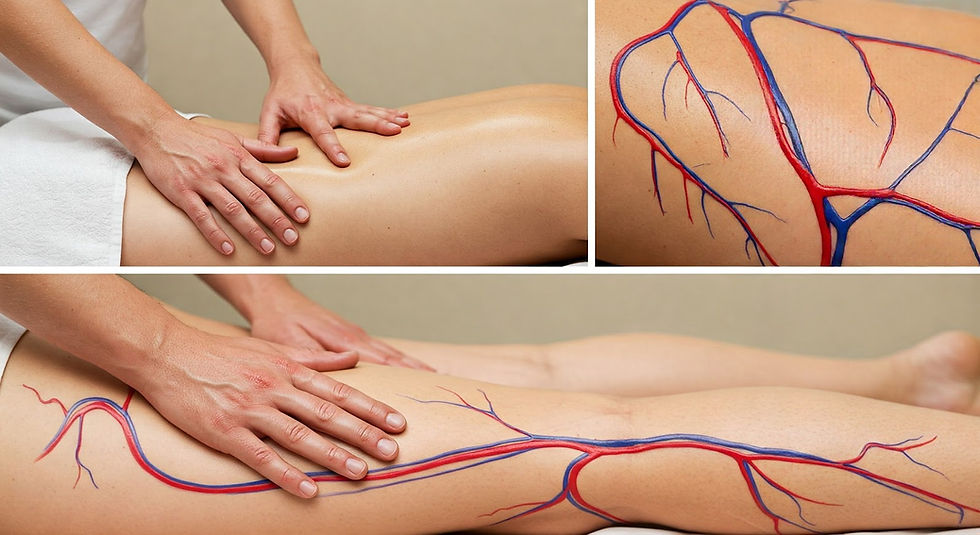
Effleurage, when performed in a deep manner, helps with circulation and flushing of the tissue. In Swedish massage, the movement is always towards the heart as fluid is pushed towards the trunk. This helps in venous return, while friction stimulates local circulation within the body. Thus, effleurage is focused on the movement of fluids and improving circulation.
Petrissage
Petrissage a deep-tissue massage technique that involves lifting, squeezing, rolling, and kneading the soft tissues and muscles. It is used to break adhesions and reach the deeper layers of muscles, all while aiming to release tension, boost blood circulation, and break down muscle knots.
Tapotement
Tapotement, or colloquially known as rhythmic striking on the body, is believed to break up mucus in the lungs and allow it to be brought out through coughing. This is a mechanical effect of the technique. Excess mucus build-up in the lungs can block airways, preventing the exchange of oxygen and carbon dioxide; thus, prolonged mucus in the lungs can also lead to infection.
It's important to mention that, by itself, tapotement has little to no effect on circulation as it is used to stimulate the nervous system instead.
Stripping (technique)
Stripping starts at one end of the muscle, then sinks in and moves towards the other end of the muscle. This action elongates the muscle and addresses any tender points along the muscle fiber.
Ischemic compression
Ischemic compression is a static compression applied to a trigger point with the therapist's thumb or fingertips, which is meant to create a blockage of blood in an area of the body so that a resurgence of local blood flow will occur when released.
Craniosacral therapy
Craniosacral therapy uses a soft touch to help release restrictions in the craniosacral system, which is comprised of the brain, spinal cord, as well as the membranes, and cerebrospinal fluid that surround and protect them. The therapy is used to improve the functioning of the central nervous system.